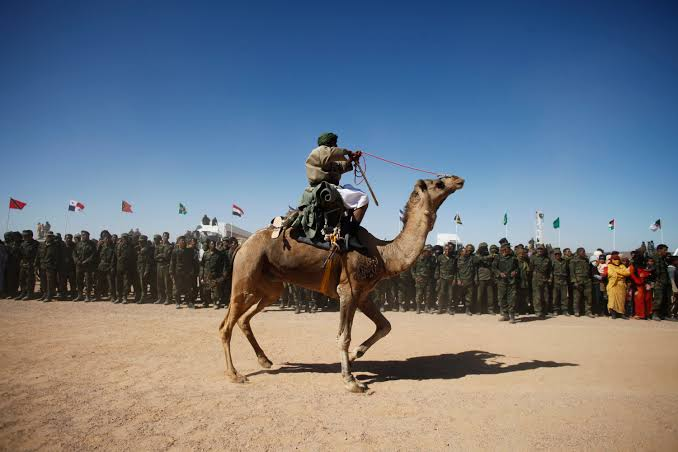
For 35 years, United Nations peacekeepers operated in one of Africa's longest-running territorial disputes. Their original mission included monitoring a ceasefire and preparing a referendum that was supposed to allow the people of Western Sahara to decide their political future.
The referendum never happened.
Now, the peacekeeping mission itself is coming to an end.
On November 1, 2026, the United Nations began winding down the United Nations Mission for the Referendum in Western Sahara (MINURSO) after the Security Council failed to renew its mandate.
The immediate cause was an extraordinary confrontation between Washington and Moscow. Russia vetoed a US-backed proposal that would have reshaped the mission and strengthened the role of Morocco's autonomy plan. A competing Russian proposal to continue the existing mission also failed to secure sufficient support.
The result is a significant change in the international management of Western Sahara: a UN peacekeeping operation is being dismantled while the territorial dispute remains unresolved.
For Morocco, the end of MINURSO represents an opportunity to advance its position that Western Sahara should remain under Moroccan sovereignty.
For the Polisario Front, which seeks an independent Sahrawi state, the development raises questions about the protection of self-determination and the future of international oversight.
For tens of thousands of Sahrawi families who have spent decades in refugee camps in neighboring Algeria, the political dispute is much more than an argument between governments.
It concerns whether they will ever be able to return home, under what political arrangements, and who will represent their interests in negotiations.
What Happened at the UN Security Council on October 30?
The diplomatic confrontation began with a proposed extension of MINURSO's mandate, which was due to expire on October 31.
Normally, the Security Council periodically renews the missions it considers necessary for maintaining international peace and security.
Western Sahara had followed this pattern for decades.
This time, however, the United States proposed substantial changes.
The American draft would have extended the mission while changing its name and placing greater emphasis on negotiations based on Morocco's autonomy proposal.
That proposal envisages Western Sahara exercising a degree of internal self-government while remaining under Moroccan sovereignty.
The United States also sought changes to the mission's structure and military presence.
Eleven Security Council members supported the American draft. Russia opposed it and exercised its veto, preventing its adoption.
Three members abstained.
Russia then presented an alternative resolution that would have extended the existing MINURSO mandate without making the same political and institutional changes.
That proposal failed to obtain the nine affirmative votes required for adoption.
Neither resolution passed.
The Security Council therefore entered November without having approved a new mandate for the mission.
On November 1, UN Secretary-General António Guterres confirmed that MINURSO would enter a liquidation phase.
A smaller administrative team will supervise the orderly return of equipment belonging to troop-contributing countries and the disposal of UN-owned assets.
The diplomatic dispute had now produced a concrete operational consequence: the UN was beginning to dismantle a mission established in 1991.
What Exactly Was MINURSO Supposed to Do?
MINURSO was established by Security Council Resolution 690 on April 29, 1991.
Its original purpose was connected to a settlement plan accepted by Morocco and the Polisario Front.
The plan envisaged a ceasefire followed by a referendum in which eligible voters would choose the territory's political future.
The referendum was never held.
Disagreements over voter eligibility and the terms of a political settlement prevented the original plan from being implemented.
Over time, MINURSO became increasingly associated with monitoring military activities and helping prevent further escalation.
Its personnel observed developments in the territory, reported incidents and maintained communication with the parties.
This work continued even after the 1991 ceasefire framework broke down in November 2020, when the Polisario Front announced a resumption of armed operations.
According to Reuters, the mission had approximately 155 military personnel and an estimated budget of $62 million for the fiscal year beginning in June 2026.
Those figures offer a useful perspective.
MINURSO was a relatively small operation when measured against the geographical size of Western Sahara and the complexity of the political dispute.
It was not an army capable of forcibly imposing a peace agreement.
Its principal contribution was observation, reporting and communication.
A limited UN presence could not resolve the underlying dispute. Nevertheless, removing it changes the arrangements through which military incidents were independently monitored.
Why Is Western Sahara Disputed?
Western Sahara covers approximately 266,000 square kilometers on Africa's Atlantic coast.
It was administered by Spain during the colonial period.
In 1975, as Spanish rule approached its end, Morocco asserted sovereignty over the territory. The Polisario Front opposed Moroccan control and pursued independence.
Mauritania was also involved in the earlier territorial dispute before withdrawing its claims.
A war developed between Morocco and the Polisario Front.
In 1991, the United Nations brokered a ceasefire, creating the conditions for MINURSO's deployment.
Morocco currently administers most of the territory, including its major population centers.
The Polisario Front controls areas east of the Moroccan-built defensive barrier and operates the Sahrawi Arab Democratic Republic, a state recognized by some countries and a member of the African Union.
But international recognition remains contested.
The United Nations continues to list Western Sahara as a Non-Self-Governing Territory, a designation it has maintained since 1963.
The International Court of Justice examined the territory's status in a 1975 advisory opinion.
It recognized that certain historical legal ties existed between the Sultan of Morocco and some tribes in Western Sahara. However, those ties did not establish territorial sovereignty sufficient to override the application of the principle of self-determination.
This legal history helps explain why the dispute has persisted despite Morocco's extensive administrative control.
Physical administration of territory, diplomatic recognition and the final determination of its international legal status are different questions.
Ending MINURSO does not, by itself, resolve those questions.
Why Did Russia Block the American Proposal?
Russia argued that the American draft placed excessive weight on Morocco's preferred political solution.
Washington's approach sought to make autonomy under Moroccan sovereignty the central framework for resolving the conflict.
Moscow objected to the Security Council effectively predetermining an outcome concerning sovereignty before the parties had reached an agreement.
Russia's UN representative, Vassily Nebenzia, argued that the Council should not impose a one-sided political framework.
The disagreement concerned more than the future of a peacekeeping mission.
It concerned what the UN should consider a realistic settlement and how the Sahrawi population's right to self-determination should be exercised.
The United States has supported Morocco's autonomy proposal as the route to a negotiated settlement.
France and the United Kingdom have also expressed support for the autonomy approach, although their official formulations have differed.
Russia's position emphasizes negotiations that do not exclude alternative political outcomes in advance.
Algeria supports Sahrawi self-determination and backs the Polisario Front.
These differences are not merely diplomatic terminology.
A settlement based on autonomy under Moroccan sovereignty would produce a different constitutional and political structure from one establishing an independent Sahrawi state.
The rights of residents, the authority of local institutions, control over natural resources and international representation would all depend on the resulting agreement.
Why Is Morocco Welcoming the Closure of MINURSO?
Morocco's royal office welcomed the failure to renew MINURSO's mandate.
In its October 30 statement, the royal office presented the development as a step toward closing the Western Sahara dispute within the United Nations framework.
Rabat has long maintained that the territory is an integral part of Morocco.
Under its autonomy proposal, local institutions would manage certain domestic affairs while Morocco retained sovereignty and central responsibilities such as defense and foreign relations.
From Morocco's perspective, the absence of a renewed referendum mission removes an institution whose original purpose is inconsistent with Rabat's preferred political settlement.
However, the Moroccan government's interpretation should be distinguished from the UN's position.
The royal office called for the matter to be removed from the Security Council's agenda.
The United Nations, meanwhile, reaffirmed on November 1 that it remained committed to supporting negotiations through the Secretary-General's Personal Envoy, Staffan de Mistura.
The end of a peacekeeping mandate therefore does not automatically terminate the wider UN political process.
Nor does it establish a new internationally agreed territorial settlement.
Those distinctions matter because diplomatic announcements can create an impression of legal finality even when fundamental questions remain open.
What Does the Polisario Front Want?
The Polisario Front seeks recognition of the Sahrawi people's right to determine their political future, including the possibility of independence.
It argues that Morocco's autonomy proposal cannot replace a process in which Sahrawis can freely decide between available political alternatives.
Following the October 30 Security Council vote, Polisario representative Sidi Omar welcomed Russia's veto of the American proposal.
He argued that the draft would have undermined the political process established around Sahrawi self-determination.
However, the rejection of the American proposal did not preserve MINURSO.
The failure of the competing Russian draft left the mission without a renewed mandate.
This creates a difficult practical situation for the Polisario Front.
Its representatives opposed proposed changes to the UN framework, but the resulting deadlock has also removed an established international monitoring presence.
The political objective of independence and the immediate operational benefits of international monitoring are separate considerations.
The consequences of losing that monitoring presence will depend on military developments and whether the parties continue cooperating with diplomatic intermediaries.
What Happens to Ceasefire Monitoring Without MINURSO?
This may be the most consequential immediate question.
Western Sahara has experienced intermittent hostilities since the breakdown of the ceasefire framework in 2020.
MINURSO continued monitoring developments and maintaining channels of communication despite those difficulties.
Without its normal operations, the international community loses an established mechanism for gathering and reporting independent information from the ground.
That can affect conflict management in several ways.
First, military incidents may become harder for outside observers to verify independently.
If one party reports an attack and the other disputes the circumstances, the absence of UN monitors could reduce the information available to assess competing claims.
Second, communication between military representatives may become less structured.
Peacekeeping missions often help relay information and address misunderstandings that might otherwise escalate.
Third, humanitarian activities operating near militarized areas may face greater uncertainty.
A UN mission cannot guarantee the safety of every civilian or humanitarian worker. But its reports and coordination can help identify risks.
These consequences are potential risks rather than proof that wider fighting has already resumed.
The withdrawal of MINURSO does not automatically mean that a new war will begin.
What it does mean is that an established mechanism for observation and de-escalation is being dismantled at a time when the underlying military dispute remains unresolved.
Western Sahara's conflict has left a dangerous physical legacy.
Large areas contain landmines and other explosive remnants of war.
Particular concern surrounds the Moroccan-built defensive barrier, commonly known as the berm, which extends for approximately 1,465 kilometers.
According to the United Nations Mine Action Service, the barrier and surrounding areas remain contaminated by mines and explosive ordnance.
That contamination affects civilian movement, humanitarian access and the safe use of land.
Mine action has been closely connected with MINURSO's activities.
The winding down of the mission therefore raises practical questions about the continuation of mine clearance, explosive-risk education and support for humanitarian access.
It would be inaccurate to assume that all mine-action activities automatically stop when MINURSO closes.
Other organizations and national or local mechanisms may continue work where funding, permission and security conditions allow.
But the transition needs clarification.
Who will coordinate information about contaminated areas?
Which organizations will remain operational?
Will personnel have access to the same routes?
Who will finance the work?
These questions deserve independent answers because landmines remain dangerous long after diplomatic decisions have been made.
More Than 170,000 Sahrawi Refugees Face an Uncertain Future
The humanitarian consequences extend beyond the disputed territory itself.
For approximately five decades, Sahrawi refugees have lived in camps near Tindouf, southwestern Algeria.
The UN's Sahrawi Refugee Response Plan for 2026–2027 uses a planning figure of 173,600 refugees across five camps.
The camps are named Boujdour, Smara, Laayoune, Awserd and Dakhla.
These names reflect Sahrawi connections with places in Western Sahara.
The population depends heavily on humanitarian assistance and community-managed services.
Desert conditions make daily life difficult.
Temperatures can exceed 50°C during summer, and water scarcity, sandstorms and flooding create additional challenges.
The UN response plan identifies requirements totaling approximately $177 million over two years.
That figure covers planned humanitarian assistance, including food security, healthcare, water, sanitation, education and other services. It should not be interpreted as money already received or available.
Importantly, MINURSO's peacekeeping budget and humanitarian assistance for the refugee camps are separate financial arrangements.
Closing MINURSO does not automatically cancel UNHCR, WFP, UNICEF or WHO assistance.
But prolonged political uncertainty can complicate the prospects for a durable settlement and voluntary return.
Oxfam warned on October 30 that the loss of the mission's monitoring functions could undermine regional security and prospects for peace.
The organization also urged donors to maintain predictable funding for refugee assistance.
For families who have lived in displacement for decades, the end of MINURSO may be another reminder that their future depends on negotiations over which they have limited control.
What About Western Sahara's Natural Resources?
Western Sahara has economic significance beyond its strategic location.
The territory contains phosphate deposits and has fishing resources along its Atlantic coastline.
Potential offshore energy resources have also attracted attention.
Control over these assets is connected to the territorial dispute.
Morocco has invested in infrastructure and economic development in the areas it administers.
Supporters of Morocco's autonomy proposal argue that an integrated economic framework could provide investment, employment and public services.
Critics question whether resource development can be considered legitimate without the consent of the Sahrawi people and whether economic benefits are fairly distributed.
These questions have also appeared in international legal disputes concerning commercial agreements involving Western Sahara.
A political settlement could affect future rules governing investment, taxation, trade, fisheries and the distribution of revenue.
The closure of MINURSO does not automatically transfer ownership of natural resources or resolve legal disputes over their exploitation.
Businesses and investors must therefore distinguish between actual administrative control and unresolved questions concerning international legal status.
This matters when evaluating infrastructure projects, extractive industries and long-term commercial contracts.
Is Western Sahara Heading Toward Another War?
The possibility of further escalation cannot be dismissed.
But the collapse of a peacekeeping mandate is not sufficient evidence that large-scale war is inevitable.
Several developments will influence the security situation.
One is the behavior of Moroccan and Polisario military forces.
Another is whether the parties maintain channels for communicating about incidents and avoiding misunderstandings.
A third is the ability of UN mediators and influential regional governments to keep negotiations active.
Algeria's position is particularly relevant because it hosts the Sahrawi refugee camps and supports Polisario's political demands.
Relations between Morocco and Algeria have remained deeply strained, and developments in Western Sahara can affect wider North African diplomacy.
The UN Secretary-General expressed concern on November 1 about possible escalation and called for restraint.
This is an assessment of risk, not confirmation that an escalation has already occurred.
The most useful indicators to monitor will be verified changes in military activity, cross-border incidents, statements from the parties and any new diplomatic initiatives.
Without independent monitoring, reliable reporting may become more difficult.
That limitation should be acknowledged rather than replaced with speculation.
Can the United Nations Still Negotiate a Settlement?
Yes.
MINURSO's closure and the continuation of the UN's diplomatic role are separate issues.
Secretary-General António Guterres stated on November 1 that the organization remained prepared to support a just, lasting and mutually acceptable political solution providing for Sahrawi self-determination.
Staffan de Mistura remains the UN Secretary-General's Personal Envoy for Western Sahara.
That means mediation can continue even though the peacekeeping operation is being wound down.
The Security Council also retains the ability to consider new proposals or adopt future resolutions.
However, passing a new resolution would require sufficient support among Council members and the absence of a veto from a permanent member.
The October 30 confrontation demonstrated that this may be difficult when major powers disagree over the foundations of a settlement.
There are several possible diplomatic approaches, including renewed talks, revised proposals for political autonomy, or discussions about a new international monitoring arrangement.
None should be presented as an agreed outcome.
Any future mechanism would require political and legal decisions, as well as arrangements for personnel, resources and access.
The immediate task for international diplomacy is to prevent the termination of an operational mission from becoming a prolonged absence of credible conflict monitoring.
Why This Crisis Matters Beyond Western Sahara
The Western Sahara dispute illustrates a recurring problem in international conflict management.
Peacekeeping operations are often created to support political agreements that remain difficult to implement.
Their personnel may continue working for decades while the underlying dispute persists.
When governments eventually question whether a mission is still appropriate, two separate issues emerge.
One concerns the mission's performance, cost and effectiveness.
The other concerns the consequences of removing it before an alternative arrangement exists.
Those questions should be evaluated independently.
A peacekeeping mission can have an outdated political objective while still performing useful monitoring functions.
Likewise, retaining an international mission indefinitely does not guarantee progress toward a settlement.
Western Sahara now presents a practical test of whether diplomatic negotiations can continue without the operational structure that accompanied them for 35 years.
The result will matter for the Sahrawi population, Morocco, Algeria and the wider region.
It will also provide a case study in what happens when the Security Council cannot agree on the future of a long-running peace operation.
Discussion 0
Sign in or register to leave a comment.