
October 31, 2026 | PressHub Africa | Health & Society
More than 5,000 people have died in the Democratic Republic of the Congo during an Ebola outbreak that began in May 2026. The country has experienced Ebola before. It has worked with international health organizations, established treatment facilities, and developed procedures for detecting and isolating infected patients.
Yet the virus continues to spread.
According to figures released by the Congolese Ministry of Health and reported by the Associated Press on October 31, the outbreak has caused 5,026 deaths among 10,351 confirmed infections. The reported case fatality ratio is approximately 48.6%.
The outbreak is now the second-deadliest Ebola epidemic ever recorded, surpassed only by the West African epidemic of 2014–2016.
But the number of deaths is not the most disturbing indicator.
Approximately 80% of newly reported infections are occurring outside previously monitored contact chains, according to Africa CDC figures cited by the Associated Press. In practical terms, health authorities are discovering most infections without having identified the patients as exposed contacts beforehand.
This makes stopping transmission considerably harder.
The central question is no longer whether Congo has the medical knowledge to respond to Ebola. It is whether that knowledge can be translated into functioning healthcare services in communities affected by armed conflict, insufficient resources, interrupted medical operations, and public distrust.
How Did the 2026 Ebola Outbreak Become So Deadly?
The outbreak was officially declared on May 15, 2026. Unlike some previous Ebola epidemics, which were caused by Ebola virus, this outbreak involves Bundibugyo virus, another member of the group of viruses responsible for Ebola disease.
The distinction matters because vaccines and treatments developed for one Ebola virus species do not automatically offer proven protection against another.
The epidemic initially affected communities in Ituri province, eastern Congo. It subsequently expanded into neighboring areas, including North Kivu, before reaching more distant provinces.
By October 20, the World Health Organization had recorded 9,704 confirmed cases and 4,687 deaths in the DRC.
Nine days later, the government's figures had increased to 10,351 cases and 5,026 deaths.
That represents an additional 647 reported cases and 339 deaths between the two reporting dates.
These are increases in cumulative reported figures, rather than a complete measure of when each infection or death occurred. Nevertheless, they demonstrate that the epidemic continued to generate a substantial burden during the second half of October.
By the end of the month, infections had been detected in 67 of Congo's 178 health zones, covering eight provinces.
The geographical expansion creates an operational problem: every additional affected health zone requires trained workers, laboratory access, protective equipment, isolation facilities, contact tracing, and safe patient transportation.
When transmission spreads faster than these services can expand, the response falls behind.
The Geography of the Crisis: Why Ituri and North Kivu Matter
Eastern Congo accounts for the overwhelming majority of reported Ebola cases.
According to October 31 reporting, Ituri and North Kivu together had recorded approximately 9,782 infections and 4,792 deaths.
Both provinces have experienced prolonged insecurity. Armed groups, displacement, attacks, and restrictions on movement have complicated the delivery of essential services.
This produces several obstacles to disease control.
A healthcare worker may know where an infected person lives but be unable to reach the village safely. A laboratory sample may take longer to arrive because transport routes are inaccessible. A family may move away from a conflict-affected area before health authorities complete contact monitoring.
Population displacement can also make it difficult to establish where an infection occurred and which individuals may have been exposed.
The consequences are especially severe for Ebola because contact tracing depends on identifying people who have interacted with infected patients and monitoring them throughout the incubation period.
According to WHO, the incubation period can range from two to 21 days.
A surveillance programme therefore requires consistent follow-up, even when the person being monitored initially feels healthy.
Maintaining that system across conflict-affected communities is substantially more difficult than establishing it in a stable urban environment.
The Most Alarming Statistic Is Not the Death Toll
The reported deaths reveal the severity of the epidemic. The proportion of infections occurring outside monitored contact chains reveals something about the effectiveness of the response.
Africa CDC figures cited by the Associated Press suggest that approximately four out of five new cases were not already linked to contacts under surveillance.
This does not necessarily mean that authorities have no information about how those patients became infected. Epidemiological investigations may subsequently establish connections.
It does mean that many cases are being detected reactively rather than through an existing monitoring network.
Consider how contact tracing is supposed to work.
When a patient tests positive, investigators identify people who may have been exposed through direct contact. Those individuals are monitored for symptoms. If one becomes ill, medical teams can arrange rapid testing and isolation.
Successful tracing reduces the time an infected person may spend receiving care at home or interacting with others without appropriate protection.
But when an infection appears outside the monitored network, health officials must reconstruct the patient's recent contacts after symptoms have already developed.
That investigation may reveal additional exposures requiring follow-up.
Every delay creates opportunities for further transmission.
The WHO's October 23 report documented another concern. Of 30,130 contacts under follow-up, only 24,017 had been seen during the previous 24 hours.
That represented a follow-up rate of 79.7%, below the required 95% threshold cited in the report.
The gap between the operational target and actual coverage is not merely administrative. It represents people whose health status could not be checked during the reporting period.
Why Are So Many Ebola Patients Dying Outside Hospitals?
The difference between receiving timely medical care and remaining untreated can be decisive.
The WHO reported that between its October 8 and October 23 updates, 307 of 482 newly reported deaths had occurred in communities rather than treatment centres.
That means approximately 64% of the deaths in that reporting interval occurred outside those facilities.
This figure applies specifically to that reporting period, not to all deaths since the outbreak began.
According to the Associated Press, WHO officials separately estimated that around one-third of deaths across the broader outbreak involved patients who died outside treatment facilities before receiving Ebola care.
These findings suggest that significant numbers of patients are reaching the healthcare system too late or not reaching it at all.
Several factors can explain delayed treatment.
Early Ebola symptoms, including fever, fatigue, headaches, and muscle pain, resemble those of other infectious diseases commonly encountered in the region.
A patient may initially suspect malaria.
Families may also delay seeking care because of transportation difficulties, insecurity, treatment costs unrelated to Ebola services, or fear of isolation.
Distrust can become particularly dangerous when communities believe that healthcare facilities are unsafe or that public health authorities are withholding information.
The longer an infected person remains at home without appropriate infection-control measures, the greater the potential for exposure among caregivers.
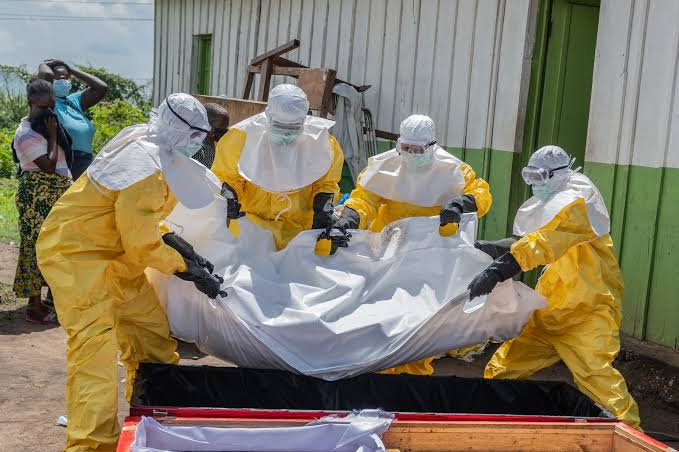
Community deaths create an additional challenge because direct contact with the body of a person who died from Ebola can transmit the virus.
This is why safe and dignified burial procedures form part of outbreak control.
They must also be implemented in ways that respect families and local traditions.
Healthcare Workers Are Fighting Two Battles
An Ebola response depends on people willing and able to work in dangerous conditions.
Yet medical teams in affected regions are facing a problem that protective equipment cannot solve: delayed salaries.
On October 30, healthcare workers at an Ebola treatment facility in Tchomia, Ituri province, went on strike over four months of unpaid wages, according to Associated Press reporting.
The facility was caring for five confirmed Ebola patients and ten suspected cases at the time.
Similar disruptions have been reported in other affected areas, including Beni in North Kivu.
For a patient with a severe infectious disease, interruption of medical services can have immediate consequences.
Treatment centres require continuous staffing to monitor patients, manage dehydration, recognize complications, maintain infection-control procedures, and prevent exposures among healthcare workers.
When staff stop working, the remaining personnel must absorb additional responsibilities or services may be suspended.
Payment delays therefore become a public health risk.
The problem extends beyond salaries. Limited supplies, insufficient transportation resources, inadequate laboratory capacity, and insecurity can all weaken the response.
The US Centers for Disease Control and Prevention has identified violence against healthcare workers and shortages of personal protective equipment as additional challenges.
The operational lesson is straightforward: supplying medical equipment is insufficient if the system cannot consistently pay, protect, and retain the people expected to use it.
Why Is There Still No Licensed Vaccine for This Ebola Virus?
One of the most significant differences between the 2026 outbreak and certain earlier Ebola outbreaks concerns the virus itself.
The licensed Ervebo vaccine targets disease caused by Ebola virus, historically associated with the Zaire Ebola virus outbreaks.
The current epidemic is caused by Bundibugyo virus.
As of October 2026, there is no licensed vaccine specifically approved to prevent Bundibugyo virus disease.
There is also no approved antiviral treatment specifically targeting this infection.
That does not mean healthcare workers have no way to help patients.
Supportive medical care, including careful management of fluids and electrolytes, monitoring of organ function, and treatment of complications, can improve the chances of survival.
However, researchers still need to establish which vaccines and targeted therapies can safely and effectively work against Bundibugyo virus.
WHO has recommended evaluating several candidate treatments through clinical trials, including monoclonal antibodies and the antiviral remdesivir.
Researchers are also investigating whether Ervebo might provide some cross-protection against Bundibugyo virus.
This possibility remains uncertain.
WHO guidance published in September states that the available evidence is insufficient to establish meaningful protection in humans and recommends use in the outbreak only within research protocols.
The European Centre for Disease Prevention and Control reported that a Phase 2/3 vaccine trial, known as TUMAINI, began in Bunia on October 23.
The trial represents an attempt to generate evidence during an ongoing emergency. Its existence should not be confused with proof that the vaccines being evaluated prevent Bundibugyo infection.
For now, rapid diagnosis, infection prevention, isolation, supportive care, safe burials, and contact tracing remain essential.
Has Ebola Spread Beyond the Democratic Republic of the Congo?
Yes. But there is an important difference between detecting imported infections and experiencing sustained transmission across an entire country.
The current outbreak has been associated with cases reported in Uganda, Kenya, Nigeria, France, and the DRC itself.
Uganda reported infections earlier in 2026. Its outbreak was subsequently declared over after the required period without new confirmed cases.
In October, the situation changed when Kenya and Nigeria confirmed infections.
Kenya's first identified patient had travelled from Congo through Uganda before arriving in Nairobi.
By October 26, Kenyan authorities had confirmed nine cases and two deaths, according to the European Centre for Disease Prevention and Control.
The subsequent infections were linked to the imported case, and health authorities had not reported wider community transmission.
Nigeria confirmed an imported case on October 20. The patient was subsequently medically evacuated to Switzerland, while health officials monitored identified contacts.
These developments demonstrate the consequences of regional mobility during an epidemic.
People routinely cross borders to work, trade, visit relatives, and access medical care. Symptoms may develop after travel, making a patient's itinerary relevant to investigations.
However, the presence of imported infections does not establish that uncontrolled transmission is occurring throughout Africa.
WHO has assessed the risk within the DRC as very high and the risk for neighboring countries sharing land borders as high, while its most recently published broader assessment placed risk at the regional and global levels lower.
Public health decisions must therefore distinguish actual transmission, potential exposure, and hypothetical future spread.
Could Closing Borders Stop the Outbreak?
Border closures may appear to offer a straightforward response when an infectious disease reaches neighboring countries.
The practical consequences can be more complicated.
Closing an official crossing does not necessarily eliminate movement between communities. It may redirect travelers toward informal routes where health screening, contact registration, and access to medical information are weaker.
WHO has advised against blanket travel and trade restrictions in response to the outbreak.
Instead, it emphasizes coordinated surveillance, detection at points of entry, communication between national health authorities, and rapid investigation of suspected cases.
National governments may adopt additional measures based on their own risk assessments. Such policies should not be confused with WHO's general recommendation.
The objective of public health screening is to identify potential exposure and connect symptomatic people with appropriate care.
Regional coordination also matters because an infection detected in one country may involve contacts in another.
Without timely information sharing, national response teams can investigate separate parts of the same transmission chain without realizing they are connected.
What Makes This Outbreak Different From Previous Ebola Epidemics?
Congo's experience with Ebola is substantial.
The country has faced repeated outbreaks, developed specialized response teams, and worked with international partners on diagnostics, treatment, surveillance, and vaccination.
Yet experience alone cannot guarantee containment.
The CDC reports that the 2026 outbreak surpassed 1,000 confirmed cases within approximately 40 days of response activation.
By comparison, Congo's 2018 outbreak took approximately 235 days to exceed that threshold.
The two epidemics unfolded under different circumstances, so the figures should not be treated as a controlled scientific comparison of transmissibility.
Nevertheless, they illustrate the speed at which the current outbreak reached a substantial reported case count.
The most consequential difference may be the combination of several vulnerabilities operating simultaneously.
The virus is spreading in areas affected by insecurity. Many patients are being identified outside monitored contact networks. Significant numbers of deaths are occurring in communities. Medical workers have reported delayed payment, and the outbreak lacks a licensed virus-specific vaccine.
Each problem makes the others more difficult to solve.
For example, insecurity can prevent contact tracing. Missed contacts can become undetected infections. Those patients may seek help late. Additional infections can increase pressure on treatment centres already struggling with staffing and supplies.
The result is a reinforcing cycle in which an outbreak creates additional strain on the systems needed to control it.
The Economic and Social Costs Extend Beyond Ebola Patients
An epidemic of this scale affects more than the people who test positive.
Families may lose income when relatives become ill, die, or must remain under monitoring.
Caregiving responsibilities may prevent household members from working. Small businesses can suffer when customers avoid crowded locations or travel becomes difficult.
Healthcare facilities may face increased demand for infection-control supplies and staff.
At the same time, people with unrelated medical conditions may delay seeking treatment because they fear exposure or because local services are overwhelmed.
These consequences do not mean that every affected community experiences the same economic disruption. Reliable local surveys would be needed to quantify lost income, school attendance, business closures, and interruptions to routine healthcare.
But the mechanisms are clear.
When a health emergency continues for months, the strain spreads beyond specialized disease-response teams into the wider social and economic life of affected communities.
For Congo, that pressure arrives alongside existing security and infrastructure problems.
This is one reason sustained outbreak response should be evaluated through more than the number of treatment beds established or medical supplies delivered.
Continuity of ordinary healthcare, transportation, worker payments, public communication, and basic community services also influence resilience.
What Would It Take to Bring the Epidemic Under Control?
The immediate requirements are not mysterious.
Authorities need to detect infections earlier, identify exposed contacts, ensure patients can receive safe treatment, protect healthcare workers, and investigate deaths occurring outside medical facilities.
The difficult part is maintaining these functions consistently across dozens of health zones.
Four operational priorities deserve particular attention.
First, strengthen community-based detection. Local healthcare providers and trusted community representatives need reliable channels for reporting symptoms, suspected exposures, and unexplained deaths.
Second, maintain continuous clinical services. Treatment capacity depends on predictable staffing, functioning supply chains, transport, and timely payment of healthcare personnel.
Third, improve contact tracing performance. Authorities need sufficient personnel and secure access to follow exposed individuals throughout the recommended monitoring period. Case detection outside established chains should trigger deeper investigations.
Fourth, sustain transparent communication. Public health guidance is more likely to be followed when communities receive accurate information, understand why specific measures are necessary, and can raise concerns without being dismissed.
International support can contribute financing, training, logistics, laboratory capability, and research expertise.
But a response also depends on national and provincial institutions being able to coordinate those resources effectively.
The success of vaccine research could eventually expand the available medical options. It cannot replace immediate infection-control measures while clinical evidence is still being developed.
What Happens Next?
The next phase of the outbreak will be determined by indicators that are more informative than a single cumulative death toll.
The first is the number of new confirmed infections reported each week.
The second is the proportion of new cases already known to contact-tracing teams before symptoms develop.
The third is the number and share of deaths occurring outside treatment facilities.
The fourth is the percentage of identified contacts successfully followed up.
Together, these measures can show whether authorities are beginning to detect transmission earlier and whether infected patients are reaching medical care.
A sustained decline in new cases would be encouraging. But it would be less reassuring if testing capacity or surveillance coverage deteriorated at the same time.
Likewise, identifying more infections may temporarily increase reported cases while demonstrating improved detection.
The distinction matters because weak surveillance can make an epidemic appear smaller than it is.
Congo's Ebola crisis has passed a devastating milestone. More than 5,000 people have died, and thousands of families have experienced the consequences of an outbreak that has continued for more than five months.
The central problem is not a complete absence of medical knowledge.
Health authorities know how Ebola spreads. They understand the importance of early diagnosis, isolation, infection prevention, safe burials, and contact tracing.
What remains uncertain is whether these measures can be delivered reliably to every affected community.
The ultimate test will be whether Congo can identify infections before they become new chains of transmission — rather than counting their consequences afterward.
Frequently Asked Questions
How many people have died from Ebola in Congo in 2026?
According to Congolese Ministry of Health figures reported on October 31, 2026, the outbreak has caused 5,026 deaths among 10,351 confirmed cases. The figures may change as additional cases are investigated and reported.
What virus is causing the Ebola outbreak in Congo?
The epidemic is caused by Bundibugyo virus, which causes one form of Ebola disease. It is distinct from the Ebola virus targeted by the licensed Ervebo vaccine.
Is there a vaccine against the current Ebola outbreak?
There is no licensed vaccine specifically approved for Bundibugyo virus disease. Researchers are investigating vaccine candidates and whether an existing Ebola vaccine may provide cross-protection.
Has Ebola spread to Kenya and Nigeria?
Yes. Both countries reported cases in October 2026. Kenyan authorities linked confirmed infections to an imported case and had not identified wider community transmission in their latest reports.
How does Ebola spread between people?
Ebola spreads primarily through direct contact with the blood or other bodily fluids of an infected person who has developed symptoms, or through contact with contaminated materials. Transmission can also occur through contact with the body of someone who died from the disease.
Discussion 0
Sign in or register to leave a comment.