

Restored from the original PressHub Africa publication of October 30, 2026. Some original media and formatting are unavailable.
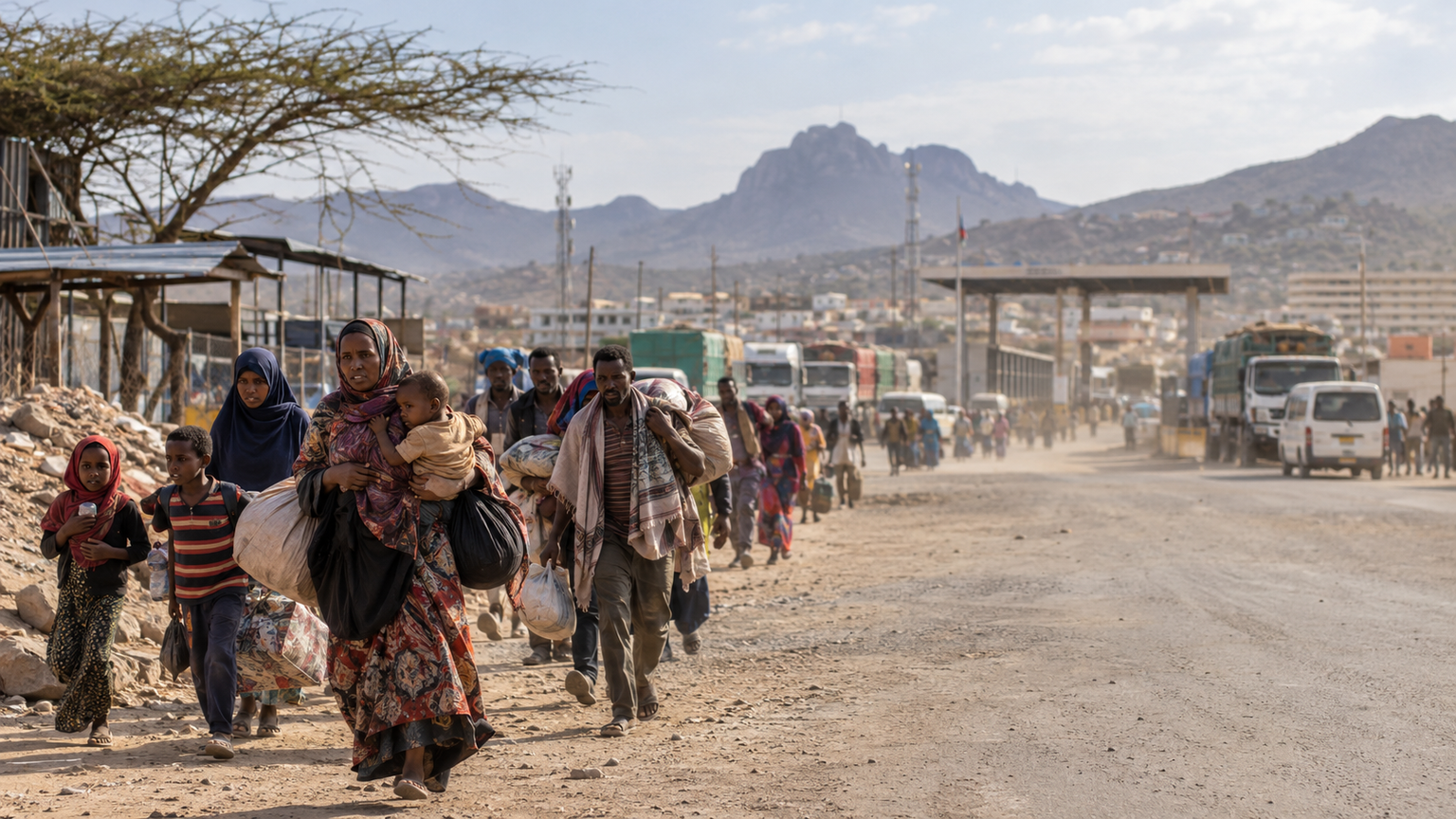
An old territorial dispute has forced tens of thousands of people across the Kenya–Ethiopia border. The fighting is also disrupting trade, overwhelming public services and exposing the vulnerability of East Africa's economic integration plans.
PressHub Africa | October 30, 2026 | East Africa, Humanitarian Crisis, Economy
In March 2026, the World Bank described the Kenya–Ethiopia border town of Moyale as an important testing ground for regional economic integration. The two countries had agreed to simplify trade procedures, reduce administrative barriers and help small businesses move goods across the border.
Seven months later, the same town is dealing with a humanitarian emergency.
Fighting between forces and armed groups associated with Ethiopia's Oromia and Somali regional states has driven tens of thousands of civilians into northern Kenya.
On October 28, the UN Refugee Agency reported that local authorities estimated up to 50,000 people had crossed the border since October 22. Kenyan media reported on October 30 that the number had reached the 50,000 mark.
These figures remain provisional. Registration and verification are continuing, and different humanitarian organisations have reported different totals.
The economic consequences are already visible. Trucks have been unable to transport goods normally through the Moyale crossing, businesses have closed temporarily, and Kenyan authorities are struggling to provide emergency services for the displaced population.
The crisis raises a question that extends beyond Ethiopia and Kenya: what happens to African regional integration when a local political dispute can interrupt an international trade corridor almost overnight?
How Did a Local Conflict Force Thousands Across the Border?
Moyale occupies a strategically important position between southern Ethiopia and northern Kenya.
The town straddles the international border and connects communities that have maintained economic, cultural and family relationships across both countries for generations.
However, the Ethiopian side has also experienced longstanding disputes involving the Oromia and Somali regional administrations.
These disagreements concern territorial boundaries, administrative authority, community representation and access to resources.
The latest escalation began around October 21–22, when armed clashes broke out in and around Ethiopian Moyale.
Reports linked the immediate tensions to disagreements over local administration and the display of a regional flag. Associated Press also reported that the killing of a 13-year-old girl had intensified the confrontation.
Neither incident adequately explains the entire conflict. The underlying territorial disputes have persisted for years, and several armed actors have been involved.
As fighting spread, civilians began crossing into Kenya.
The displacement accelerated rapidly.
On October 26, the International Organization for Migration reported approximately 36,600 arrivals. The Kenya National Commission on Human Rights subsequently reported around 40,000 displaced people. By October 28, UNHCR was citing local estimates as high as 50,000.
The numbers describe a rapidly evolving emergency rather than a completed population count.
Kenya's Border Communities Are Absorbing the Shock
The first consequence of the conflict is the sudden increase in demand for basic necessities.
According to the Kenya National Commission on Human Rights, more than 15,000 people were staying in temporary shelters as of October 27, while over 20,000 were living with relatives and friends.
Schools, churches and other community facilities have been used to accommodate displaced families.
This distribution matters economically.
Humanitarian assessments often focus on formal camps, but a substantial proportion of the arrivals are being supported directly by local households.
A family taking in displaced relatives may need to buy additional food, obtain more drinking water and share already limited sanitation facilities.
These costs accumulate even when no formal invoice is issued.
The pressure is particularly serious in Marsabit County, where access to reliable water supplies and healthcare infrastructure is already a concern.
The human rights commission has warned that overcrowding, inadequate sanitation and rainfall could increase the risk of communicable diseases.
The organisation also reported that four women had given birth in temporary accommodation sites, highlighting immediate requirements for maternal and newborn healthcare.
If the displacement continues, emergency accommodation may also interfere with education, particularly where schools are being used as shelters.
Kenya is therefore facing two connected responsibilities: protecting people escaping the fighting and preventing additional hardship among communities hosting them.
The Economic Problem: Moyale Is More Than a Border Town
The immediate humanitarian crisis has received international attention. The disruption to cross-border business deserves closer examination.
Moyale is situated on a transport corridor connecting Nairobi and Addis Ababa.
Agricultural products, manufactured goods and everyday consumer supplies move through this route. Small traders also depend on regular cross-border transactions for household income.
On October 25, the Kenya News Agency reported that commercial activity at the border had been disrupted.
Trucks were unable to move goods normally in either direction, and several shops near the One-Stop Border Post had closed because of insecurity.
This creates several economic consequences.
The first is interrupted inventory turnover.
Small businesses often operate with limited working capital. They buy goods, sell them and reinvest the revenue in the next shipment.
If the border becomes unsafe, this cycle stops.
Businesses may still have obligations to suppliers, lenders, landlords and employees even when sales disappear.
The second problem is perishability.
Food traders face additional losses when fresh products cannot reach markets before their quality deteriorates.
A delayed shipment may generate a lower selling price or become unsellable altogether.
The third is increased transport risk.
When drivers cannot predict whether a crossing will be accessible, they must account for delays, vehicle security and uncertainty over delivery schedules.
These costs can reduce profit margins and make cross-border trade less attractive.
There is currently insufficient verified information to calculate the total value of trade lost during the October disruption. Any precise estimate would require customs data, traffic counts and evidence on delayed or cancelled shipments.
Nevertheless, the mechanism of economic damage is already apparent: commercial activity depends on predictable access, and armed conflict has made that access uncertain.
The Irony: Kenya and Ethiopia Had Just Started Simplifying Trade
The October emergency becomes more significant when examined alongside developments earlier in 2026.
In December 2025, Kenya and Ethiopia signed a bilateral agreement establishing a Simplified Trade Regime at Moyale.
The initiative was intended to reduce procedural barriers for smaller traders.
According to a World Bank analysis published on March 25, 2026, the arrangement included a bilateral 10% tariff reduction for qualifying goods that met applicable COMESA rules of origin.
However, the regime also imposed restrictions.
The ordinary simplified framework limited traders to goods worth $1,000 per month and one border crossing per week.
It also restricted eligible trading areas to 50 kilometres inside Ethiopia and 100 kilometres inside Kenya.
For small businesses dealing in fresh produce, these restrictions could reduce the benefits of faster customs procedures.
The World Bank noted that most small-scale traders in Moyale are women, many of whom depend on frequent transactions and informal business networks.
A six-month pilot involving 50 traders from both countries was therefore introduced to test higher transaction limits, more frequent crossings and simpler procedures.
This was supposed to help determine how regional trade regulations could better reflect the realities of small businesses.
The October fighting has exposed a problem that customs reform alone cannot solve.
A trader may have access to simplified documentation and improved border facilities, but these advantages lose much of their value when the surrounding area becomes unsafe.
The effectiveness of a trade corridor depends on security and political stability as well as infrastructure.
How Large Is the Humanitarian Response Gap?
On October 28, UNHCR announced that it was mobilising essential household items and temporary shelter materials intended to support nearly 12,000 people.
The same statement cited local estimates of up to 50,000 arrivals.
At face value, the initial relief-supply target represents approximately 24% of that estimated population.
This comparison does not mean that only 24% of displaced people were receiving assistance. Other agencies, government authorities and host communities are also providing support, and the figures measure different aspects of the emergency response.
It does, however, illustrate the difficulty of scaling assistance when displacement rises rapidly.
UNHCR is coordinating with Kenya's Department of Refugee Services, county authorities, the International Organization for Migration, UNICEF, the World Food Programme, the Kenya Red Cross and other humanitarian partners.
The most urgent requirements include food, clean drinking water, sanitation, shelter and healthcare.
The agency is also working with authorities to identify safer accommodation away from the immediate border area.
That last measure reflects another concern: the violence has not been confined entirely to the Ethiopian side in terms of its physical consequences.
Kenyan authorities have reported incidents involving stray bullets crossing the border, while local officials have expressed concern about further escalation.
Could the Conflict Spread Into Kenya?
A humanitarian crisis does not automatically become a security conflict inside the receiving country.
However, the situation in Moyale presents several identifiable risks.
The first is the possibility of further cross-border gunfire or armed incidents.
The second concerns tensions between communities connected to the groups involved in the Ethiopian dispute.
The third is the circulation of inflammatory or misleading information.
On October 29, Kenyan authorities reported investigations involving seven individuals suspected of spreading messages that could inflame tensions.
Marsabit Governor Mohamud Ali urged community leaders and residents to avoid inflammatory rhetoric and support a peaceful resolution.
Kenyan security forces have increased patrols around the border and accommodation sites.
The challenge is to maintain security without restricting lawful humanitarian assistance or treating displaced civilians as combatants.
Kenya's National Commission on Human Rights has emphasised that reception, registration and protection measures must remain consistent with the country's legal obligations.
These include protection against returning people to situations where they face serious threats to their lives or safety.
Why This Conflict Matters Beyond Kenya and Ethiopia
Africa's regional integration agenda depends heavily on stronger transport connections, simplified customs procedures and the movement of goods between neighbouring countries.
Moyale demonstrates how security conditions can determine whether those investments generate economic returns.
The African Continental Free Trade Area seeks to reduce barriers between African markets, but tariff reforms cannot independently guarantee the uninterrupted movement of goods.
Border businesses require three things at the same time: workable trade regulations, functioning infrastructure and a reasonably predictable security environment.
When one fails, the benefits of the others decline.
For example, a better highway can reduce transport time under normal conditions. But an unsafe border crossing may leave a truck stranded regardless of the road's condition.
Likewise, simplified customs paperwork cannot prevent financial losses if sellers cannot access their customers.
The current crisis illustrates why border security, local governance and conflict prevention have direct economic significance.
What Happens Next?
Three developments will determine the immediate direction of the crisis.
First, whether fighting in Ethiopian Moyale stops. A durable reduction in violence is necessary for displaced families to consider returning safely and voluntarily.
Second, whether humanitarian assistance expands. The urgent test is whether food, water, healthcare and safe accommodation can keep pace with the number of people requiring support.
Third, whether normal cross-border commerce resumes. Continued transport interruptions would increase pressure on small businesses and households dependent on trading activity.
Authorities will also need to monitor whether the violence affects additional communities and whether temporary displacement becomes prolonged.
The October emergency has demonstrated the connection between local governance disputes and regional economic stability.
In March, Moyale represented a practical experiment in making African trade easier.
By October, it had become an example of how quickly conflict can interrupt that progress.
For thousands of displaced families, the immediate priority is safety. For businesses, it is restoring access to markets. For both governments, resolving the underlying dispute will be essential if the border is to function as a source of economic opportunity again.
Discussion 0
Sign in or register to leave a comment.